
Dog Age Calculator & Converter
Convert your dog’s age into an easy human-age estimate based on age, size, breed, and calculation method.
≈ 1 dog year
Calculate Your Dog's Age
Enter your dog's age or birthday to get an approximate human-age equivalent.
Human-age conversions are approximate. Breed, size, genetics, development, lifestyle and calculation method can affect the estimate.
Why the 7-Year Rule Is Only a Rough Guide
Dogs do not age at exactly seven human years for every year of their lives.
Fast Early Development
A dog's first two years represent a much faster period of development than later years. A 1-year-old dog is often estimated at around 15 human years, while a 2-year-old dog is around 24 human years.
Size Matters
Small, medium, large and giant dogs can mature and age differently. Adult size can therefore provide useful context when interpreting an age estimate.
Biology Is More Complex
Genetics, body condition, development, lifestyle and health history can all influence how an individual dog ages.
Dog Years to Human Years
A commonly used practical comparison for understanding approximate dog age.
| Dog Age | Approximate Human Age |
|---|---|
| 1 year | 15 human years |
| 2 years | 24 human years |
| 3 years | 29 human years |
| 4 years | 34 human years |
| 5 years | 39 human years |
| 6 years | 44 human years |
| 7 years | 49 human years |
| 8 years | 54 human years |
| 9 years | 59 human years |
| 10 years | 64 human years |
There Is More Than One Way to Convert Dog Years
A 2020 study examined DNA methylation and proposed a non-linear relationship between dog and human aging. The model illustrates why age does not increase at a constant rate.
What Does the Number Actually Mean?
- It is an approximate human-age equivalent.
- It is not a literal biological age.
- Different calculation methods can produce different results.
- A calculator should explain which method it uses.
Months Matter for Young Dogs.
A 6-month-old puppy and a 12-month-old dog are both young, but can be at very different points in physical and social development.
Context Makes Estimates More Useful.
When available, breed and adult size can add context. Mixed-breed dogs can still be estimated using chronological age and approximate size.
Age Conversion Is Not the Same as Life Stage.
Veterinary life-stage guidance considers puppy, young adult, mature adult and senior stages alongside individual characteristics.
Make Age Calculations Easier
Use related resources when comparing ages or learning how chronological age is calculated.
Age Difference Calculator
Compare dates and ages when you need a more precise chronological calculation.
Explore age difference →More Calculators
Explore practical tools designed to turn everyday questions into simple calculations.
Visit home →Questions or Feedback?
Learn more about the site or get in touch through the dedicated information pages.
Contact us →Dog Age Calculator FAQs
How old is my dog in human years?
It depends on chronological age, size, breed and the conversion method. A commonly used estimate places a 1-year-old medium-sized dog at about 15 human years and a 2-year-old dog at about 24.
Is one dog year really seven human years?
The 7-to-1 rule is a traditional approximation. It does not account for rapid early development or differences between dogs.
Can a birthday be used to calculate dog age?
Yes. A birthday-based calculator can determine chronological age in years, months and days, then apply an approximate human-age conversion.
Does breed affect dog age?
Breed and body size can affect maturation and life stages. They are useful context, but they do not provide an exact biological age.
Does weight determine a dog's human age?
No. Weight alone cannot determine biological age. It can help classify approximate size, especially when breed information is unavailable.
When is a dog considered a senior?
There is no universal chronological age. AAHA describes the senior stage as the last 25% of a dog's estimated lifespan through the end of life, so timing varies.
Is a dog age calculator 100% accurate?
No. It provides an estimate based on a selected method and available information. It should not be presented as an exact biological measurement.
Dog Years Are Not Fixed at Seven Human Years.
A useful estimate considers chronological age, months for puppies, breed, adult size, body condition, developmental stage, life stage and the calculation method. For individual health or age-related concerns, a veterinarian can provide a personalized assessment.
Calculate Your Dog's Age“How old is this dog in human-age terms?”
It depends on the dog’s age, size, and breed. A dog’s human-age equivalent can be estimated using a dog age calculator.
“How much food may this dog need?”
It depends on the dog’s age, weight, size, and activity level.

How Much Should a Dog Eat Based on Age and Weight?
Age calculations and feeding calculations are related to pet care, but they should not be confused.
Owners searching for how much should i feed my dog calculator by age are usually looking for a feeding estimate based on factors such as:
Age
Body weight
Activity level
Growth stage
Breed or size
Food type
Health requirements
A puppy, adult dog, and senior dog may have different nutritional requirements. Likewise, two dogs of the same age can need different amounts of food because their weight and activity levels differ.
Dog Life Stages Explained
Understanding Life Stages Can Make An Age Calculation More Useful.
Puppy Stage
Puppy Age Calculator in Weeks & Human Years. The puppy stage is characterized by rapid growth and development.
During this period, dogs may experience:
Rapid physical growth
Teething
Socialization
Training
Behavioral development
Increasing coordination
Changes in nutritional needs

Young Adult Stage
- Young adulthood begins after the most rapid puppy development has passed.
- The dog may continue to mature physically and behaviorally particularly depending on breed and size.
- At this stage, the dog may have reached its adult body size but still be developing in other ways.
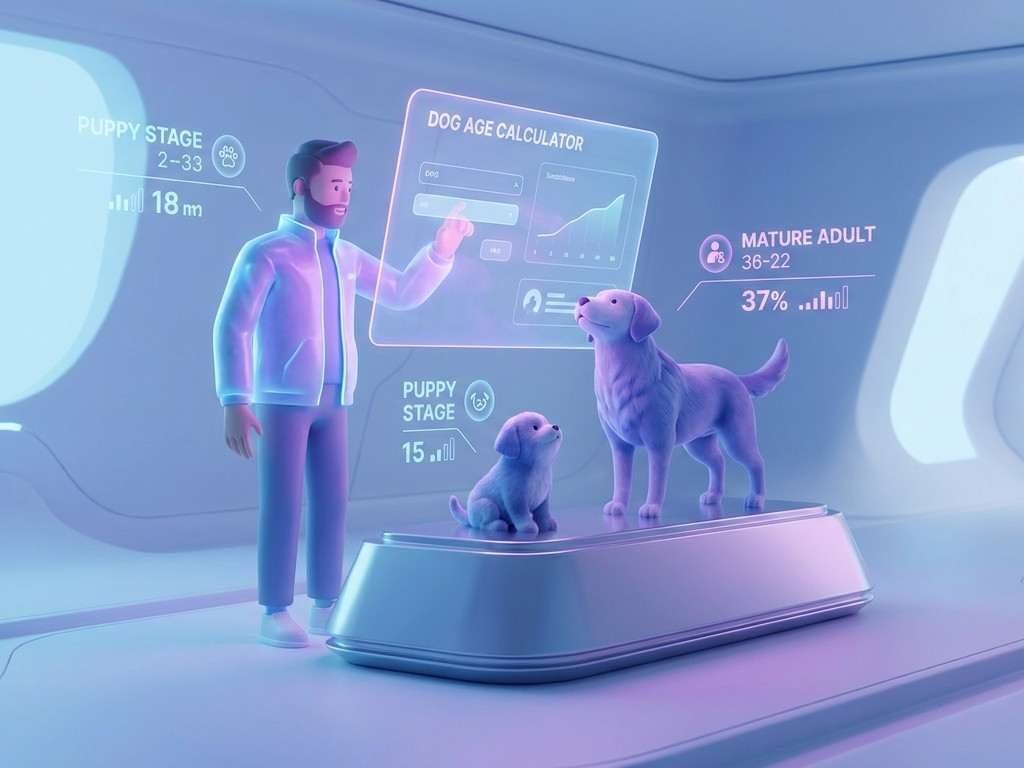
Mature Adult Stage
- A mature adult dog has moved further into adulthood.
- The human-age equivalent may continue to increase, but the exact comparison depends on the selected calculation method.
- Lifestyle becomes particularly relevant during this stage.
- Exercise, nutrition, weight management, preventive care, and regular veterinary checkups can all contribute to overall well-being.
Senior Stage
- There is no single age that makes every dog a senior.
- A smaller dog and a giant breed can reach later-life stages at different chronological ages.
- Veterinary guidance can define senior status in relation to the final portion of a dog’s expected lifespan rather than applying one universal birthday to every dog.
- This is another reason that a human-age conversion should not be used as the sole definition of a dog’s health or life stage.

Common Mistakes When Calculating Dog Age
When Ussing a “Dog Age Calculator” Always Remember This 7 Mistakes.
Mistake 1: Always Multiplying by Seven
The seven-year rule is simple but does not represent rapid early canine development.
Mistake 2: Ignoring Size
A small dog and a giant dog may have different aging patterns.
Mistake 3: Ignoring Puppy Months
A six-month-old puppy is not developmentally identical to a 12-month-old dog.
Mistake 4: Treating Weight as Age
Weight can provide information about size but cannot independently determine biological age.
Mistake 5: Assuming Breed Gives an Exact Answer
Breed provides useful context but cannot account for every individual difference.
Mistake 6: Treating the Human Number as Biological Age
The calculated human-age equivalent is a comparison.
Mistake 7: Comparing Results Without Checking the Method
Different formulas can produce different results.
Dog Age and Nutrition Through Different Life Stages
Dog age calculator with exact calculation. Age can still play an indirect role in nutrition.
Puppies
Growing puppies generally have nutritional requirements associated with growth and development.
Their feeding needs can change rapidly as they grow.
Adult Dogs
Adult dogs generally require nutrition appropriate for maintaining body condition and activity.
Senior Dogs
Older dogs may experience changes in activity, metabolism, body composition, dental health, or medical needs.
However, chronological age alone does not determine the correct diet.
This is why age should be considered alongside weight, activity, body condition, food composition, and health status.
Sources
- Wikipedia – Dog
- Wikipedia – Aging in Dogs
- Wikipedia – List of Longest-Living Dogs
- Heads Up For Tails – Dog Age Calculator
- PetMD – How Old Is My Dog in Human Years
- WebMD – How to Calculate Your Dog’s Age
- AAHA – Dog Aging Project
- PubMed – Dog Aging Study
- Purina UK – Your Dog’s Age in Human Years
- AKC – How to Calculate Dog Years to Human Years